Blue whale
The WhaleThe Blue whale is at once an immense living animal, a constructed museum image, and a measure of industrial whaling’s destructive reach. The book follows its transformation from a creature that people could scarcely observe in its element to a life-size effigy suspended in a museum hall, and then to a species devastated by modern hunting. That history unsettles the confidence of display and classification: even a model large enough to dominate a building cannot make the whale fully present, while the fleets that could kill it did not thereby understand what they were destroying.
An oceanic animal and an elusive presence
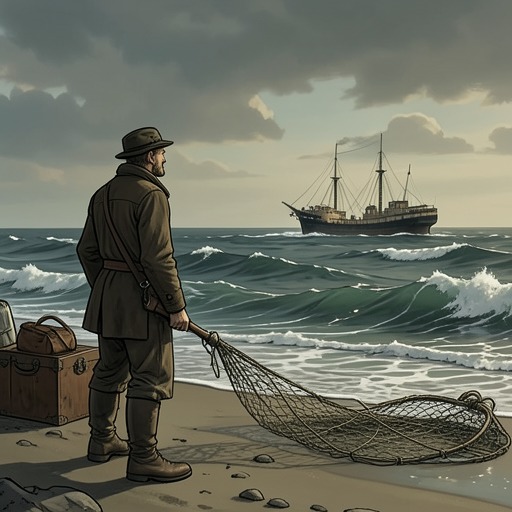
The book places whales within an ocean that resists being reduced to scenery or distance. The sea sustains human life, shapes coastlines and movement, and remains a wilderness even where cities reach its shores. Its appearance can shift from a broad spectacle to a nearly invisible surface, and its changes happen on scales that ordinary observation can miss. Against that account, the Blue whale’s enormous size does not make it readily knowable: the animal’s life belongs to a medium that people mostly encounter from outside.
The contrast between the sea’s enduring character and the vulnerability of particular whales is central. The ocean may remain wild across human history, but its inhabitants do not remain untouched by human action. The book’s account of the Blue whale makes that distinction concrete. A species can occupy the largest scale of animal life and still be reduced by a technology and industry designed to find and kill it. Its physical magnitude offers no protection against systems that turn a sighting into a harvest.
The whale made visible in a museum
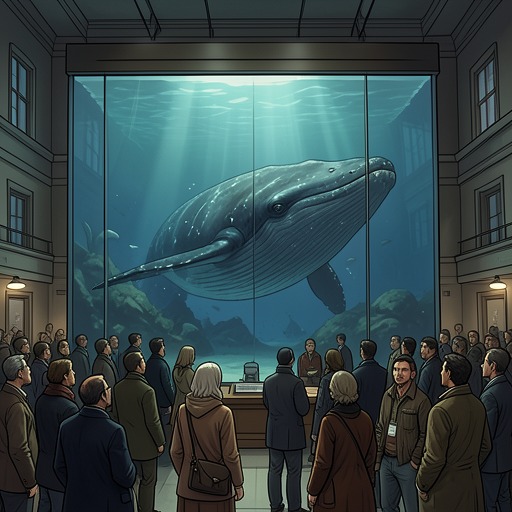
At the Natural History Museum, London, the visitor’s route passes displays of vanished animals before opening into a hall dominated by a suspended Blue whale. Nearly one hundred feet long, from its nose to its twenty-foot flukes, the model is larger than the narrator remembers from childhood. Its open mouth and small eye give it an expressive appearance, but the display is not a preserved whale or a cast of a complete living animal. It is a hollow construction of wood, wire and plaster, made to approximate a creature that its makers had never seen alive in its element.
The model’s history makes its limits part of its meaning. Plans for a new Whale Hall had been raised in 1914 and revived in 1923, when the museum’s director, Sidney Harmer, argued that the existing displays could not give visitors a satisfactory idea of major whale species. The proposal joined public education to an explicit concern about protecting whales from extinction. It also served a scientific purpose: the hall was meant to promote research associated with expeditions to South Georgia, where scientists worked alongside the British whaling fleet.
An initial scheme proposed obtaining a Blue whale, suspending it in an engraving dock and taking a mould. The plan proved too experimental and was abandoned. In 1937, the museum’s technical assistant and taxidermist Percy Stammwitz instead proposed building the model within the hall. He and his son Stuart spent nearly two years making it from measurements taken by scientists in South Georgia. They cut wooden cross-sections from large paper patterns, joined them with slats at three-foot intervals, covered the frame with wire netting and applied plaster. During construction, the workers used the model’s interior as a canteen. The structure that would later appear to contain the whale had first been a workplace built around an absence.
Completed in December 1938, the effigy looked convincing enough that The Times thought casual visitors might mistake it for a stuffed whale. A telephone directory and coins were placed inside as a time capsule. On the eve of war, the placid model became a memorial to a short interval of peace; museum warders also placed pennies on its flukes to encourage visitors to leave coins for luck, later collecting them for the pub. Its public life thus exceeds its function as an anatomical representation: it gathers scientific ambition, popular fascination, wartime memory and small acts of custom into a single fabricated body.
Capture and industrial use
The difficulty of representing the Blue whale contrasts with the growing ease of killing it. Harpoon guns had been used since the early nineteenth century, but Sven Foyn’s grenade harpoon and steam-powered methods opened the great rorquals, including Blue whales, to commercial pursuit. These animals had previously been beyond the reach of older whaling methods. Once sighted by the newer hunters, they could be treated as effectively doomed. The book presents this technical shift not as a neutral advance but as an expansion of extraction into the lives of the largest animals on earth.
The economic setting had changed as well. Sperm and right whales had been depleted, while petroleum and gas had reduced the price of whale oil. Whalers turned toward species and grounds not yet exhausted. In 1904, Norwegian and British steamships began operating in the Antarctic, where whale products also served a new industrial demand: the manufacture of nitroglycerine. The whale’s body could thus be made to support a world preparing for war. During the two global conflicts, tens of thousands of whales died, and the book links the killing of animals to the industrial violence that their products helped supply.
Factory ships intensified the process. The first, the Lancing, was launched in Norway in 1925. These vessels enabled hunting and processing at sea, and the book describes the resulting slaughter of rorquals on a scale that made continued exploitation untenable. In one account of a Blue whale among the largest ever caught, the animal was weighed only after being cut into pieces and put on the ship’s scales: it weighed 300,000 pounds. Its tongue weighed three tons, its heart was as large as a car, and the arteries were wide enough for a person to swim through. Those measurements do not restore the whale as a living presence; they show how completely a body could be translated into units of processing.
Protection, decline and commercial extinction
International attempts to regulate hunting gathered force as the scale of the catch became harder to ignore. At the 1937 London conference, the British Minister of Agriculture and Fisheries warned that the Blue whale would be exterminated if hunting continued at its existing rate. The resulting convention restricted pelagic whaling for most of the year and included protections for certain species, calves, females accompanied by calves and whales below a specified size. These measures marked a shift toward regulating the industry, but the scale of prior and continuing hunting would make protection difficult to turn into recovery.
In the twentieth century, 360,000 Blue whales were killed, reducing the population to about one thousand. By the 1960s the species was, for practical purposes, commercially extinct. The distinction matters: commercial extinction describes a population depleted to the point that hunting is no longer commercially viable, not a claim that every Blue whale had disappeared. The book’s figures make visible the gulf between an animal’s extraordinary size and a population’s fragility. Industrial killing could turn abundance into scarcity within a historical span measured not in geological ages, but in generations of human activity.
The museum model and the history of whaling therefore stand in uneasy relation. One is a vast, hollow likeness built because a living Blue whale could not be studied in its natural element; the other is a record of fleets that found ways to reach and process the animal at extraordinary scale. The model can preserve a public image, and its size can make the whale difficult to ignore, but it cannot substitute for the living species. Its presence in a hall devoted to natural history carries the contradiction forward: the whale is displayed as an enduring giant even as the history attached to it records how close human industry brought that giant to disappearance.